AI in Everyday Life: How Artificial Intelligence Is Transforming Work, Homes, and Daily Decisions
Artificial intelligence is no longer a futuristic concept reserved for tech labs and sci-fi movies. Today, AI in Everyday Life is quietly shaping how people work, manage their homes, make decisions, and interact with the digital world. From smart assistants and recommendation engines to workplace automation and predictive analytics, AI has become deeply embedded in daily routines—often without users realizing it.
As technology advances rapidly, understanding how AI affects everyday experiences is no longer optional. Whether you are a professional, business owner, student, or casual technology user, staying informed helps you adapt smarter, protect privacy, and use AI tools effectively. This guide explores how artificial intelligence is transforming work, homes, and decision-making, while also addressing benefits, risks, and future trends beyond 2026.
Table of Contents
What Does “AI in Everyday Life” Really Mean Today?
What is AI in everyday life? It refers to artificial intelligence systems that operate behind the scenes to automate tasks, personalize experiences, and assist decision-making in routine activities such as work, home management, shopping, and entertainment.
Artificial intelligence today functions largely as an invisible assistant. Algorithms analyze behavior patterns, learn preferences, and continuously adapt without requiring direct user input. Unlike earlier AI models that needed manual commands, modern AI systems operate passively, improving efficiency and convenience.
Smartphones, social platforms, navigation apps, and even banking systems now rely on AI to deliver faster and more relevant results. This shift has made AI not just a tool—but an everyday companion.
For a broader understanding of how AI fits into the global innovation cycle, explore our detailed analysis of Technology Trends 2026.
AI in the Workplace: Smarter Productivity and Intelligent Automation
How is AI changing work environments? AI enhances productivity by automating repetitive tasks, supporting decision-making, and enabling employees to focus on creativity, strategy, and high-value responsibilities.
Artificial intelligence has reshaped the modern workplace faster than any previous technology wave. From content creation and customer support to data analysis and project management, AI tools are now essential for efficiency.
AI Tools Improving Daily Workflows
- AI writing and editing assistants
- Automated email sorting and responses
- Smart scheduling and meeting summaries
- Predictive analytics for business decisions
Instead of replacing jobs entirely, AI supports professionals by reducing manual workload and minimizing errors. Employees now spend less time on routine tasks and more time on problem-solving and innovation.
Real-World Use Case: AI for Small Businesses
Small businesses benefit significantly from AI-driven tools:
- Chatbots handle customer queries 24/7
- AI marketing platforms personalize campaigns
- Inventory systems predict demand accurately
These developments reflect patterns highlighted in our coverage of latest technology news in 2026, where AI adoption continues to accelerate across industries.
AI in Smart Homes: Comfort, Efficiency, and Security
How does AI improve home life? AI-powered smart homes learn user behavior, automate routines, enhance energy efficiency, and strengthen security through predictive and adaptive systems.
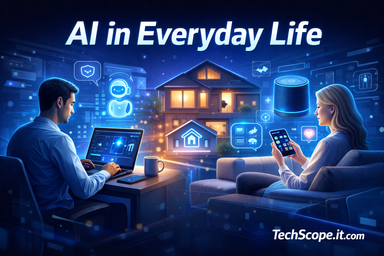
Smart homes represent one of the most visible examples of AI in Everyday Life. Devices no longer follow fixed commands; instead, they learn habits and adjust automatically.
AI-Powered Home Assistants
- Voice-controlled assistants manage schedules and reminders
- Smart thermostats adjust temperature based on usage patterns
- Intelligent lighting systems adapt to time and mood
Home Security and Energy Optimization
AI-driven security systems analyze motion patterns and facial recognition data to reduce false alarms. Energy management tools optimize consumption, lowering utility costs while supporting sustainability goals.
These systems demonstrate how AI improves daily comfort while operating quietly in the background.
AI in Daily Decision-Making: Subtle Influence, Powerful Impact
Does AI affect everyday decisions? Yes—AI influences what people watch, buy, read, and prioritize by analyzing behavior patterns and delivering personalized recommendations.
Every digital interaction generates data, and AI systems use this information to guide decisions—often subconsciously.
Personalization Engines at Work
- Streaming platforms recommend shows and music
- Online stores suggest products based on browsing history
- News feeds prioritize relevant topics
AI in Financial and Health Choices
- Budgeting apps analyze spending behavior
- Fitness apps personalize health routines
- AI-powered reminders improve habit formation
While personalization improves convenience, it also raises questions about transparency and data control.
Key Benefits of AI in Everyday Life
Why do people rely on AI daily? AI saves time, reduces errors, improves personalization, and enhances accessibility—making everyday tasks more efficient and intuitive.
Major Advantages
- Time-saving automation
- Improved accuracy in tasks
- Personalized digital experiences
- Accessibility for users with disabilities
AI has become a productivity multiplier rather than a replacement for human effort.
Risks, Ethical Concerns, and Limitations of Everyday AI
What are the risks of AI in everyday life? Concerns include privacy invasion, algorithmic bias, over-dependence on automation, and lack of transparency.
Key Challenges
- Data privacy and surveillance
- Bias in algorithms
- Reduced human decision control
- Security vulnerabilities
Responsible AI use requires awareness, ethical design, and regulatory oversight to ensure trust and safety.
How Businesses and Developers Are Adapting to Everyday AI
How are organizations responding to AI integration? Companies are shifting from short-term innovation to long-term intelligent systems that evolve continuously through data and user feedback.
Instead of yearly radical redesigns, companies are refining user experience through software intelligence and adaptive algorithms. Once these AI trends become visible, businesses and developers begin adjusting long-term strategies rather than offering short-lived innovation. This shift becomes especially important during global tech showcases where future trends are unveiled and analyzed. This is why many industry experts closely follow major events like CES, as highlighted in this detailed report on AI and tech trends in 2026 that explores AI agents, robotics, and next-generation systems.
The Future of AI in Everyday Life Beyond 2026
What’s next for AI in daily life? The future points toward autonomous AI agents, deeper personalization, emotional intelligence, and closer human-AI collaboration.
Emerging Directions
- Autonomous AI agents managing tasks independently
- Emotion-aware AI interfaces
- Seamless integration across devices and platforms
As AI matures, its role will shift from assistant to collaborator.
Frequently Asked Questions
Is AI already part of everyday life?
Yes, AI powers smartphones, apps, smart homes, and online services used daily.
Can AI improve productivity?
Absolutely. AI automates routine tasks and supports better decision-making.
Is AI safe for everyday use?
When designed responsibly, AI is safe, though privacy and ethics must be monitored.
Will AI replace human jobs?
AI is more likely to augment roles rather than replace them entirely.
Conclusion: Living With AI, Not Competing Against It
Artificial intelligence is not replacing human intelligence—it is enhancing it. AI in Everyday Life has become a silent partner that improves efficiency, comfort, and decision-making across work, homes, and personal routines. The key to benefiting from AI lies in understanding its role, using it responsibly, and staying informed as technology evolves.
As we move beyond 2026, those who adapt thoughtfully to AI will not only keep pace with change but thrive in a smarter digital world.